40 Instagram Post Ideas for Hair Salons
By IndieAM ·
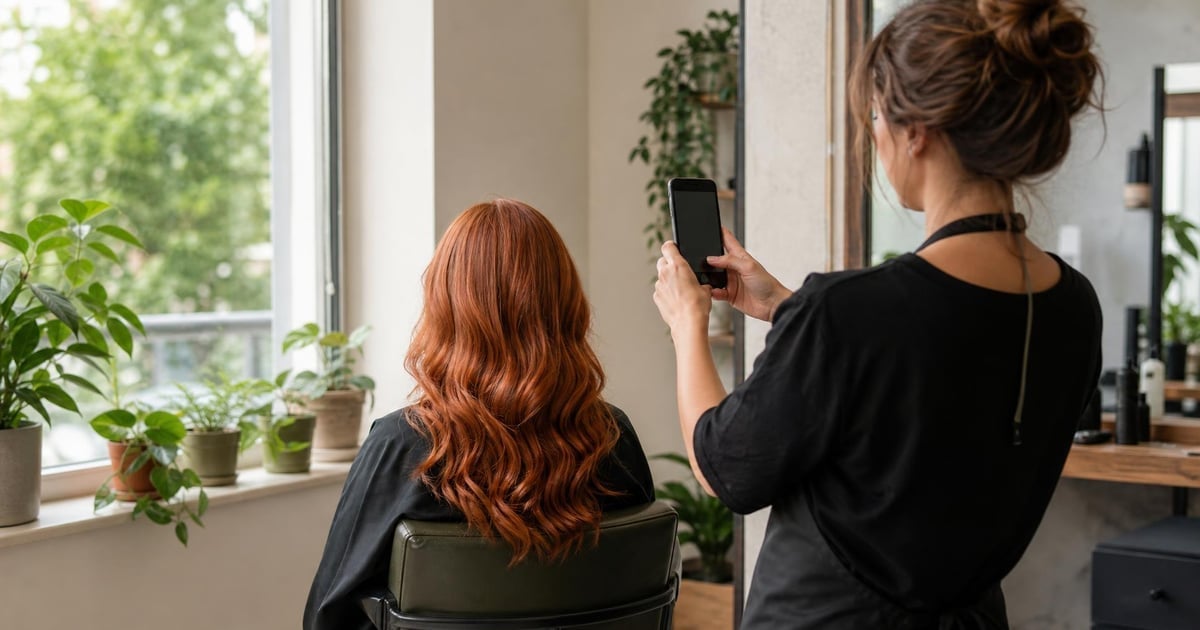
The best Instagram posts for a hair salon show what happens before and around the finished look, not only the look itself. Clients already know you can do hair. What they want to know is how you work, who'll be holding the scissors, and whether you'll listen. Below are 40 ideas grouped by type, each with the format that tends to suit it. Pick four or five and post them over the next two weeks.
The examples are made up to show the idea. Swap in your own services and skip anything that doesn't fit your salon.
Why "just post your best work" isn't enough
A feed of finished looks is a good portfolio. The trouble is that every salon has one, and after a few weeks they start to blur together, even for you.
Instagram's Adam Mosseri has said the platform's top ranking signals are watch time, likes and sends. That was said in January 2025, and platforms change, but the idea is useful: a post does well when people keep watching and send it to a friend. People rarely send a stranger's highlights to a friend. They do send "this is how to explain the color you want" to the friend who's been nervous about going lighter.
So mix your finished looks with posts that teach, introduce and reassure. That's what most of this list is.
Show the work
- The finished look, from more than one angle. Front, side and back in a carousel. The back is what the client can't see, and it's often your best angle.
- Before and after. Only with the client's yes, and in the same light both times so the change is honest.
- The grow-out. The same client six or eight weeks later. For lived-in color or a good cut, this proves more than day one does.
- The process in 15 seconds. Sectioning, painting, the rinse, the blow-dry. A Reel with no talking is fine.
- A close-up of the technique. The brush on a section, the point-cutting, the placement of a foil. It shows the care people miss from across the room.
- The color formula moment. The bowl, the swatch, the mixing. You don't need to share the formula.
- Hair that isn't a dramatic change. A clean-up, a trim that grew out well, a glossing service. Most appointments look like this, and so do most of your future clients.
- Texture you're good at. Curls, coils, very fine hair, very thick hair. If you love working with it, show it often.
Before the appointment
- What happens in a consultation. Step by step, as a carousel. It answers the question nervous clients won't ask.
- How to describe the color you want. Words like warm, cool and soft, and what to point at in a photo.
- Why that saved photo might not translate. Different light, different length, different starting color. Kindly said, this saves you a hard conversation in the chair.
- What to bring. Two or three photos you like, one you don't, and your honest routine.
- How to arrive. Hair in its everyday state, no heavy dry shampoo, or whatever you prefer.
- How long it really takes. "A full head of hand-painted color is usually most of an afternoon, and here's why." Use your own numbers.
- Three questions to ask before going lighter. Upkeep, cost over a year, and what happens if you change your mind.
- What a patch test is and why you ask for one. A short, reassuring text post or Story.
Meet the salon
- Meet the owner. Why you opened, and what you still love about it. Keep it short.
- Meet each stylist. One post each: what they love doing most, and the clients they're best with.
- A day in the salon. Five photos from one day, from first coffee to sweeping up.
- Your space. The chairs, the light, the wash basins, the view. People like to know where they'll sit for three hours.
- The products you use, and why. Not a sales pitch, just your reasoning.
- Your tools. The scissors you've had for years, the brush everyone asks about.
- Something you're learning. A course, a new technique, a trade show. It shows you keep getting better.
- A small salon ritual. The tea you offer, the playlist, the head massage at the basin.
Between visits
- How to make color last. Washing less often, cooler water, the right shampoo. Your real advice.
- How to style it at home in five minutes. A Reel on a stylist or a willing regular.
- What to do about brassiness. A common worry, a simple answer.
- Heat and your hair. When to use protection, and why.
- Swimming and summer sun. Simple care tips for the season.
- When to book your next appointment. For each service, the usual gap and why.
Bookings and news
- Openings this week. "Two color appointments left on Thursday." Only when it's true.
- A new stylist or a new service. Who they are and what they do.
- Holiday hours. Plain and useful. Post them early, and again the day before.
- Gift cards. How to buy one, and who they're good for.
- Wedding hair, explained. What a trial involves and how far ahead to book.
- A reason to come in during a quiet stretch. A real reason with a real end date, like a January gloss offer.
Your clients and your neighborhood
- A client's story, in their words. With their permission, and without changing what they said.
- A real review. A screenshot or a quote from Google, with the reviewer's first name only.
- A neighbor you love. The café next door, the florist across the street. They may well return the favor.
- This or that. "Copper or strawberry blonde for fall?" A poll in Stories is easy to answer.
Which format to use
You don't need to master every format. A simple rule of thumb:
- Reels for anything that moves: the process, styling at home, a quick tip said to camera. Here's how to make Reels with just your phone.
- Carousels for anything with steps: the consultation, what to bring, front-side-back.
- Single photos for a finished look, a new stylist, your space.
- Stories for openings this week, polls, and anything that's only true today.
What if clients don't want to be in photos?
Plenty won't, and that's fine. You still have more to show than you think:
- The back of the head. Often the best view of color and shape anyway.
- Hands and tools. The brush, the foils, the bowl, the scissors.
- Your team's own hair. Stylists often enjoy being the model.
- Swatches and products. A swatch ring says "color" without a face.
- Your space. The chairs, the basins, the window light.
Always ask before you post a client, and ask again if it's a child. Ask in writing if you can, so there's no confusion later. And if someone asks you to take a post down, take it down.
Four things to keep you out of trouble
- Keep the photo honest. Shoot in the same good light each time, by a window if you can, and skip heavy filters. A client who books for a filtered color and gets the real one won't be happy.
- Be careful with popular music. Osborne Clarke warns that most platform music libraries aren't licensed for commercial use. Use a platform's commercial collection, royalty-free music, your own sound, or none.
- Be honest about freebies. If a client got something free in return for a post or a review, the FTC says that should be disclosed, and a discount can't depend on the review being positive.
- Only claim what's true. "Best balayage in town" needs to be something you can stand behind. This isn't legal advice, so ask a professional if you're unsure.
How many of these should you post?
Three good posts a week is plenty for most salons, and we go through the evidence in how often to post. A simple mix for one week:
- one post that shows the work (1-8),
- one that helps someone before or between visits (9-16, 25-30),
- one that introduces the salon or your news (17-24, 31-36).
Repeat your favorites. A second consultation carousel isn't boring. It's a new client reading it. And if you want to plan a whole month in one go, here's how to plan a content calendar in one sitting.
If you'd rather not write them yourself
Ideas are the easy part. Writing captions after a full day on your feet is the hard part. You could:
- Set aside half an hour a week and write three posts at once.
- Hand it to someone on your team who enjoys it, and give them real time for it.
- Hire a freelancer. Here's what a social media manager costs.
- Use software that does the writing. IndieAM, which we make, plans a month of posts for your salon and writes every caption in your voice. Here's one it wrote for a made-up salon on our sample page:
Trying to explain the color you've got in your head? It's harder than it sounds. Bring a few photos that show the tone you like, use simple words like warm, cool, or soft, and point out exactly what caught your eye - the ends, the roots, how the light moves through it. The clearer the picture, the easier it is to talk it through together.
You approve the plan and each post, and approved posts publish themselves to the Instagram, Facebook and TikTok accounts you connect. It adds pictures from your photo library, and makes AI pictures for scenes that don't have to be your salon, like a swatch ring. Photos of your real work have to come from you. It won't reply to comments or take bookings. You can see how it works for hair salons.
Or start with number 9 today. You explain the consultation every day already. Write it down, add a photo of your swatch ring, and post it.